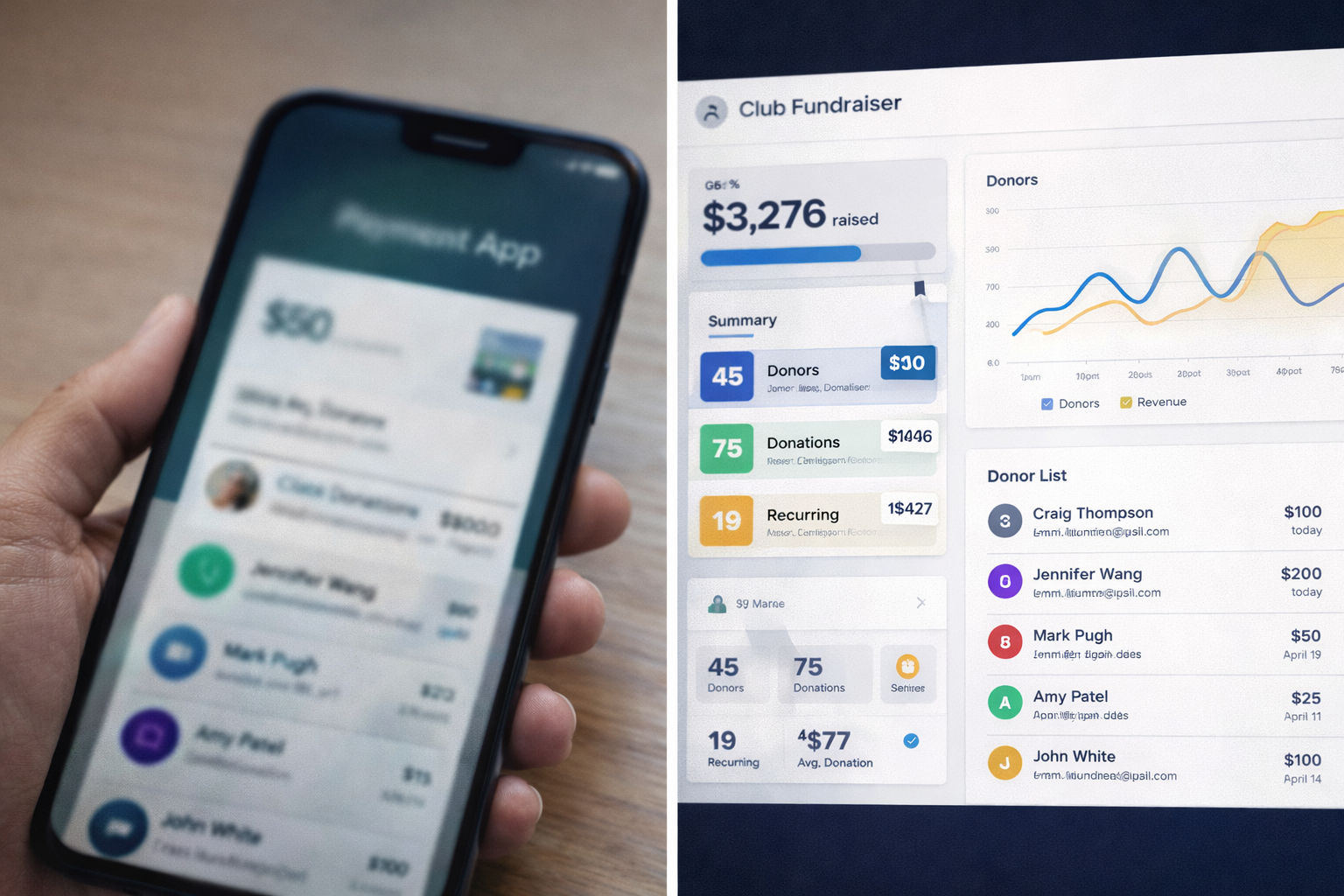
Let's be fair upfront: GoFundMe, Venmo, and CashApp are good products. They're just not the right products for running a sports team's finances.
GoFundMe was built to help individuals raise money for a single cause (a medical bill, a community project, a family in need). Venmo was built to send money between friends. CashApp was built for the same thing with a different interface. None of them were built for an organization that needs to collect dues from 40 members, run multiple fundraising campaigns a year, track alumni donations, manage a contact database, and hand it all off to a new officer every 12 months.
But because nothing better existed in their price range (free), club sports teams, rec leagues, and student organizations have been duct-taping these consumer tools together for years. Here's where that breaks down.
GoFundMe: The One-Campaign Trap
GoFundMe does one thing well: it creates a compelling page for a single fundraising campaign with social proof (donor count, recent contributions, comments) and an easy payment flow. Credit where credit is due.
Here's what it doesn't do:
No ongoing relationship with donors. When someone donates to your GoFundMe, you get their money but not a real connection. There's no way to tag them, add them to a contact list, email them next season, or track their giving history over time. Every campaign starts from zero. Every. Single. Time.
No dues collection. GoFundMe is built for variable, voluntary contributions, not fixed-amount payments from a defined list of people. You can't create a dues campaign that says "each of these 40 people owes $500" and tracks who's paid.
No roster or contact management. GoFundMe doesn't know who's on your team. It doesn't know who's a player, who's a parent, and who's an alum. It's a fundraising page, not an organizational tool.
No email or communications. You can't send an email campaign to your donors, segment your audience, or track engagement over time. Once a campaign ends, the connection ends.
Platform economics are murky. GoFundMe removed its platform fee but now prompts donors with a "tip" that defaults to a significant percentage. Donors often don't realize this tip goes to GoFundMe, not to the team. The opt-out experience is deliberately friction-heavy. Not great.
One-off by design. GoFundMe campaigns are meant to be temporary. They launch, they run, they close. But a sports team's financial needs aren't one-off. You need to collect dues every semester, run a fundraiser every spring, accept alumni donations year-round. GoFundMe's model doesn't support continuous operations.
Venmo and CashApp: The Tracking Black Hole
Peer-to-peer payment apps are the default for club sports teams because they're what everyone already has on their phone. Makes sense. But using them for team finances creates problems that compound over time.
No audit trail. Venmo transactions are a stream, interleaved with personal payments, rent splits, and dinner tabs. Isolating team-related transactions requires manual work. CashApp is the same. Good luck at the end of the semester figuring out what's what.
No receipts. Neither platform generates a proper receipt that shows what a payment was for, which organization it went to, and the breakdown of the transaction. This matters for teams with any financial oversight requirements.
No way for outsiders to pay. If an alum wants to donate and they're not on Venmo, you're stuck. There's no public payment page, no credit card option, and no way for someone to contribute without installing an app and connecting to the treasurer's personal account.
Money flows to personal accounts. Venmo payments to a team go to the treasurer's personal Venmo balance. Commingling team funds with personal funds is a recipe for accounting headaches, disputes, and (in worst cases) misappropriation concerns. It's not malicious, but it's messy.
No donor management. There's no way to see "total contributions from John Smith across all campaigns." There's no way to tag a donor, record their graduation year, or flag them as a recurring supporter. Every payment is a disconnected event.
Zero institutional knowledge. When the treasurer graduates, their Venmo history goes with them. The next treasurer has no record of past payments, no list of who owes what, and no way to verify claims about prior dues. Sound familiar?
Stripe Payment Links: Better, But Still Incomplete
Some teams graduate to Stripe payment links. A step up from Venmo for sure. Stripe is a legitimate payment processor that generates real receipts and deposits money into a business bank account.
But a Stripe payment link is just a link. It doesn't give you:
- A campaign page with a description, goal progress, or social proof
- Donor management or contact records
- A way to track dues by member
- Email communication tools
- A roster or alumni directory
- Any organizational layer on top of the payment
It's a checkout page. That's useful, but it's not a fundraising platform.
What Teams Actually Need: An All-in-One Platform
The core problem with all of these tools is fragmentation. When you use GoFundMe for campaigns, Venmo for dues, a Google Sheet for the roster, Mailchimp for emails (if you can afford it), and a group chat for coordination, you end up with:
- Data scattered across five platforms
- No unified view of your team's finances or contacts
- Manual reconciliation that eats hours every month
- Institutional knowledge that evaporates every year
What club sports teams need is a single platform that handles everything:
| Capability | GoFundMe | Venmo/CashApp | Stripe Link | Fieldraiser |
|---|---|---|---|---|
| Campaign pages with goal tracking | Yes | No | No | Yes |
| Card and ACH payments | Card only | Venmo/Cash balance | Yes | Yes |
| Dues collection with member tracking | No | No | No | Yes |
| Recurring donations | No | No | Yes | Yes |
| Donor receipts | Limited | No | Yes | Yes |
| Contact/donor management | No | No | No | Yes |
| Roster management | No | No | No | Yes |
| Alumni directory | No | No | No | Yes |
| Email campaigns | No | No | No | Yes |
| Calendar integration | No | No | No | Yes |
| Survives leadership turnover | Somewhat | No | Somewhat | Yes |
| Free for teams | Yes* | Yes | Yes | Yes |
*GoFundMe is technically free for organizers but generates revenue through donor-facing tips with high default percentages.
Making the Switch
If your team is currently running on Venmo and GoFundMe, switching to Fieldraiser doesn't mean throwing everything away. It means consolidating.
- Create your org on Fieldraiser and connect Stripe. This takes about 10 minutes.
- Import your existing contacts. If you have a roster spreadsheet, CSV import it. If you have alumni email addresses anywhere, get them in the system.
- Create your next campaign on Fieldraiser instead of GoFundMe. Your donors won't notice a difference in the payment experience. It'll actually be better, with card and ACH options.
- Run your next dues cycle through a Fieldraiser dues campaign instead of Venmo requests. You'll see who's paid in real time without manual tracking.
- Send your next team email through Fieldraiser instead of Gmail or Mailchimp. Track opens, clicks, and responses.
Each step replaces one tool with a better version. After a month, you've consolidated five platforms into one, and the next officer who takes over inherits all of it.
The Right Tool for the Job
GoFundMe is great for what it was built for. Venmo is great for what it was built for. But running a sports team's finances isn't what either of them was built for, and the gaps show.
Fieldraiser was built specifically for club sports teams, rec leagues, and scrappy organizations: the ones too big for Venmo and too small for Salesforce. It's free, it's comprehensive, and it's designed to be the one tool your team actually needs.
Stop duct-taping consumer apps together. Use something built for the job.