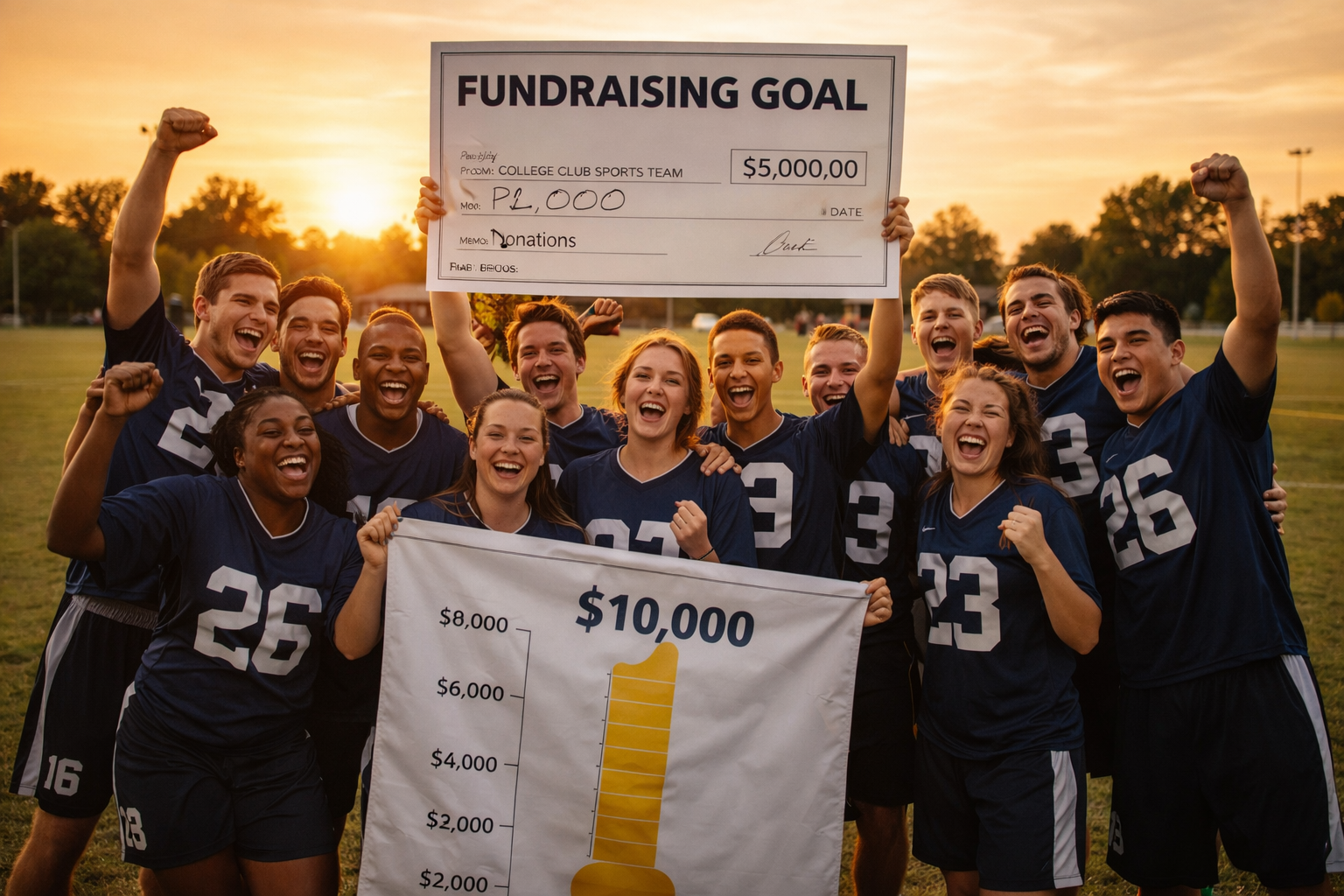
Every semester, thousands of club sports teams face the same question: how do we pay for this? Dues cover part of it. Maybe the university kicks in a small allocation. But there's almost always a gap. And filling that gap is the difference between a team that scrapes by and one that actually thrives.
Most teams default to the same tired playbook. A car wash that raises $300 after six hours of work. A bake sale that nets $150. A "fundraising night" at a restaurant where 10% of sales goes to the team and the total ends up being $87.
These aren't fundraising strategies. They're time sinks disguised as effort.
The teams that raise real money, $5,000, $10,000, or more per campaign, do something different. They go online. They reach their full network. And they make giving easy. Here's how.
Why Traditional Fundraisers Fall Short
There's nothing wrong with a car wash as a team bonding activity. But as a revenue strategy, it has a fundamental math problem.
A car wash reaches the people who happen to drive by your location on a Saturday afternoon. That's maybe 40-60 cars at $10-15 each. After supplies, you're looking at $400-700 for an entire day of work across 20+ team members. That's roughly $2 per person per hour.
Now compare that to an online campaign shared with your alumni, parents, and extended network. A single email to 200 alumni, with a 15% open rate and a 10% conversion rate, at an average gift of $75, raises $225. That email took 30 minutes to write and send.
The math isn't close. Online fundraising reaches more people, costs less effort, and generates more money. Every time.
This doesn't mean you should never do in-person events. It means you should never rely on them as your primary fundraising strategy. The foundation should be online. Everything else is bonus.
Who Actually Gives to Club Teams?
Before you build a campaign, you need to understand your donor base. For college club teams, it breaks down into three groups:
Parents. They're already financially invested in their kid's experience. Many are happy to give beyond dues if you ask clearly and make it easy. The average parent donation on Fieldraiser is about $100-150 per campaign.
Alumni. Former players who had a great experience on the team and want to give back. Alumni are your long-term donor base. They give year after year. But you have to stay in touch with them and actually ask. Most teams don't.
Extended network. Grandparents, aunts, uncles, family friends, and local businesses. These people won't seek you out, but when a player shares a campaign link on social media or forwards it directly, they'll often give $25-50. It adds up fast when you have 30 players each sharing with their own network.
The mistake most teams make is only asking current players to contribute. Your team of 35 players has a network of hundreds of potential supporters. You just need to reach them.
Building Your Campaign
Set a Specific Goal
Don't just say "we're raising money for the team." Say "we're raising $8,000 to cover tournament travel this spring." People give more when they know exactly what their money does. Be specific about the amount and what it funds.
Good goals are tied to something tangible:
- "$6,000 for spring tournament travel (flights, hotels, entry fees)"
- "$4,500 for new equipment and uniforms"
- "$10,000 to cover the gap between dues and our total season budget"
A progress bar on your campaign page does real psychological work. When donors see "68% funded," they want to help push it over the line. Set a goal that's ambitious but reachable, and let the momentum build.
Write a Story, Not a Pitch
Your campaign description shouldn't read like a budget spreadsheet. It should tell the story of your team. Why does this team matter? What do players get from the experience? What's at stake if you can't fund the season?
A few paragraphs is all you need. Include a team photo. Mention specific things: the conference tournament in March, the new players who joined this year, the tradition you're building. Make it personal. Donors give to people, not line items.
Set Suggested Giving Levels
Don't leave the amount field blank and hope for the best. Suggest specific amounts and explain what each one covers:
- $25 covers a player's tournament entry fee
- $75 covers a player's hotel stay for an away tournament
- $150 covers a full travel package for one player
- $500 sponsors the team for a full tournament weekend
Suggested amounts anchor expectations. Without them, many people default to the minimum. With them, the average gift goes up significantly.
Timing Your Campaign
When you launch matters almost as much as how you promote it. Here's what works:
Beginning of semester, not end. Launch your campaign in the first 2-3 weeks of the semester. Enthusiasm is high, the season is ahead, and parents are already in "spending mode" from tuition and fees. By finals week, everyone is checked out and broke.
2-3 weeks is the sweet spot. A campaign that runs for one week doesn't give enough time for sharing and follow-up. A campaign that runs for six weeks loses urgency. Two to three weeks is ideal: long enough to reach everyone, short enough to maintain momentum.
Avoid holiday overlap. Don't launch a campaign the week of Thanksgiving or during winter break. People are distracted, traveling, and spending money on other things. January and September are the strongest months for club sports fundraising.
Promoting Your Campaign
A campaign page that nobody sees raises nothing. Promotion is where most teams drop the ball. Here's a promotion plan that actually works:
Day 1: Launch and Direct Outreach
Share the campaign link in your team group chat and ask every player to forward it to five people: parents, grandparents, family friends, whoever. This first wave of direct outreach generates the majority of your donations. Personal asks convert at 5-10x the rate of social media posts.
Days 2-5: Social Media Push
Have players share the campaign on their personal Instagram stories and other social channels. The key word is personal. A post from the team's account reaches your existing followers. A post from 30 players' individual accounts reaches thousands of unique people.
Day 7: Email Your Alumni and Parents
Send a dedicated email to your alumni and parent list. Include the campaign link, the progress so far ("We're already at 40%!"), and a clear ask. This is often the highest-converting single action in the whole campaign.
Days 10-14: Final Push
Send a "last chance" message to all channels. Urgency works. "We're $1,200 away from our goal with 3 days left" is a powerful message. People who meant to give but didn't will act when they see the deadline approaching.
After the Campaign
This is where most teams fail, and it costs them future donations.
Thank every donor. Personally if possible, through the platform at minimum. A thank-you message within 48 hours of someone's gift is the single most important thing you can do to get them to give again next time.
Report back. After the campaign ends, send a brief update to everyone who donated. Tell them the final total, thank them again, and explain what the money will fund. "Thanks to your support, we raised $7,800, enough to cover all five of our spring tournaments." That's the kind of message that turns a one-time donor into a repeat donor.
Save the data. Every donor's contact info and giving history should be stored somewhere permanent. Not in a spreadsheet that lives on one person's laptop. On Fieldraiser, every donation is logged to a contact record, so next year's fundraising chair knows exactly who gave, how much, and when.
What Realistic Results Look Like
Here's what a well-run online campaign typically produces for a college club team:
| Team Size | Network Reach | Campaign Goal | Typical Result |
|---|---|---|---|
| 20-30 players | 150-300 people | $3,000-5,000 | $2,500-6,000 |
| 30-50 players | 300-600 people | $5,000-10,000 | $5,000-12,000 |
| 50+ players | 500-1,000+ people | $10,000-20,000 | $8,000-25,000 |
These numbers assume an active promotion effort and a campaign that lasts 2-3 weeks. Teams that set up a page and don't promote it will see a fraction of these results. The campaign page is the tool. Promotion is the work.
Get Started This Week
If your team needs to raise money this semester, don't wait. The best time to launch a campaign is at the start of the semester. The second best time is right now.
Set up your campaign page on Fieldraiser (it's free, takes about 15 minutes), write your story, set your goal, and share the link. Your network is bigger than you think. You just have to ask.